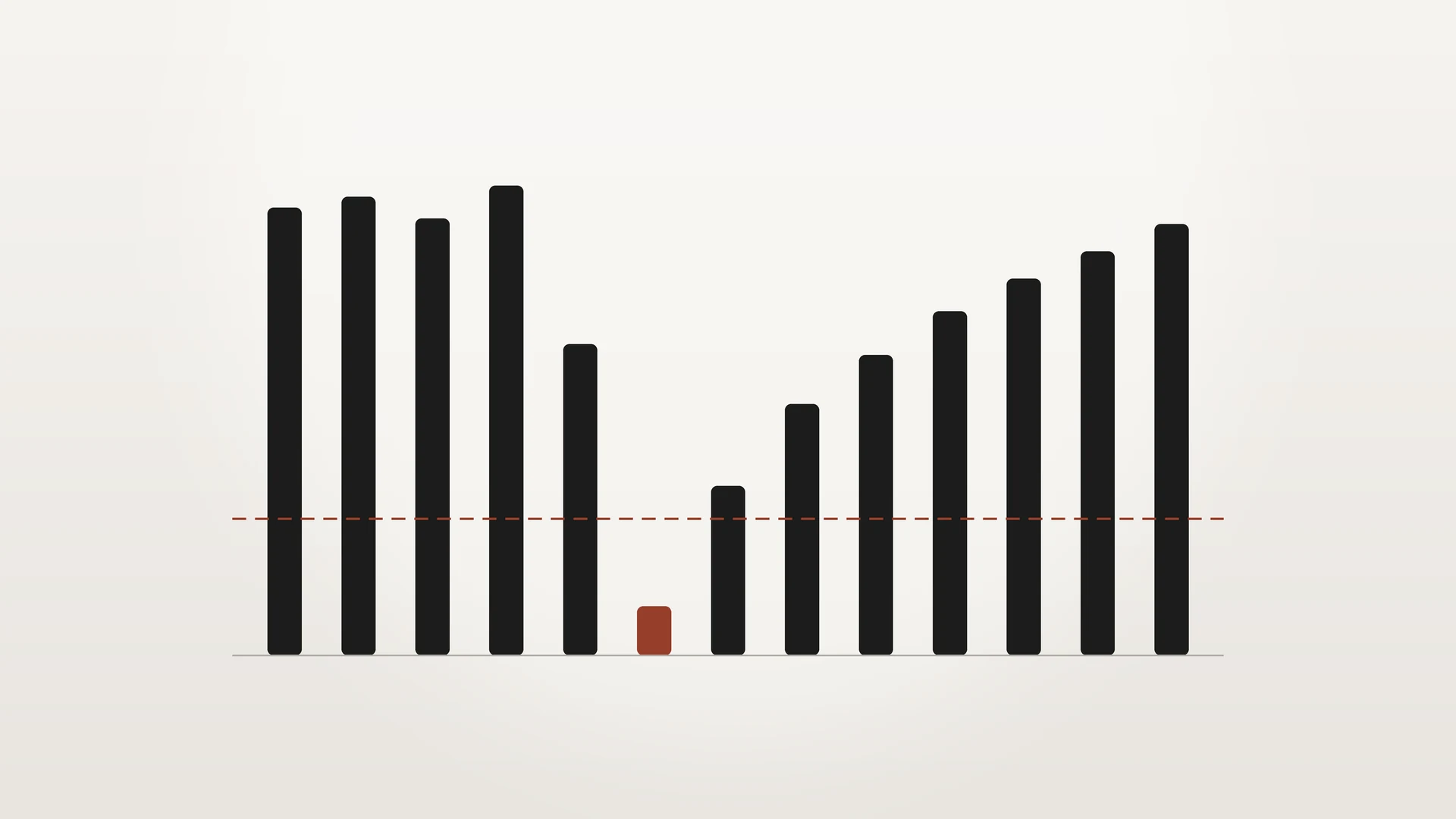
A 13-week cash flow forecast shows, week by week, how much cash will come in, how much will go out, and the lowest balance you'll hit over the next quarter. It takes about two hours to build in a spreadsheet and 15 minutes a week to keep current, and it's the simplest way for a small business to see a cash crunch coming early enough to act.
Profit and cash are not the same thing. A business can be profitable on paper and still miss payroll, because customers pay in 45 days while rent, wages and suppliers are due this week. The 13-week forecast closes that gap. It ignores accounting timing and tracks only one thing: when money actually moves.
Why 13 weeks
Thirteen weeks is one quarter. It's long enough to catch the slow-paying invoice, the quarterly tax instalment and the annual insurance renewal, and short enough that you can predict each week with real accuracy. Monthly forecasts hide the problem: a month can end with a healthy balance even though the account dipped below zero on the 12th.
Step 1: Start with today's real cash balance
Log into the bank and write down the actual balance across every operating account. Not the accounting software's balance, the bank's. Everything that follows builds from this number, so it has to be true.
Step 2: List your cash coming in, week by week
For each of the next 13 weeks, enter the cash you expect to receive, and when.
- Open invoices: put each one in the week the customer actually tends to pay, not the due date. If a client always pays 20 days late, forecast it 20 days late.
- Expected new sales: be conservative. Only include work that is signed or highly likely.
- Other inflows: loan draws, tax refunds, owner contributions, asset sales.
Step 3: List your cash going out, week by week
Work through every payment the business makes and place it in the week it will leave the account.
- Payroll, on its real pay dates.
- Payroll remittances. In Canada, most small employers remit source deductions monthly, due the 15th of the following month (CRA).
- Rent, loan payments, leases and subscriptions.
- Supplier bills, on the dates you plan to pay them.
- GST/HST or sales tax payments, income tax instalments and annual costs like insurance.
- Owner draws or dividends.
The annual and quarterly items are the ones that cause surprises. Go through last year's bank statements once to catch them.
Step 4: Calculate the weekly ending balance
For each week: opening balance, plus cash in, minus cash out, equals closing balance. The closing balance becomes next week's opening balance. Once the 13 columns are filled, find the lowest closing balance. That number is the most important figure in the whole forecast.
A simple example (illustrative figures). A 15-person services firm opens with $82,000 in the bank. Weekly cash in averages $38,000, and weekly cash out averages $36,000, so it looks fine. But in week 6, payroll, a quarterly tax instalment and a $14,000 software renewal all land while a $40,000 invoice is paid late. The balance drops to $9,000 that week, below the $25,000 the owner wants as a floor. Seeing that six weeks ahead turns a crisis into a phone call: chase the invoice early, move the renewal to monthly billing, or line up the credit facility before it's needed.
Step 5: Set a minimum cash floor
Decide the lowest balance you're comfortable holding, often two to four weeks of operating costs. Highlight any week that falls below it. Those weeks are where your decisions need to happen.
Step 6: Update it every week and compare
Every Monday, replace last week's forecast with what actually happened, then add a new week 13 at the end so the window rolls forward. Note where forecast and actual differed and why. After a month or two, your forecast will get noticeably more accurate, and you'll know exactly which customers and costs to watch.
What to do when the forecast shows a gap
- Speed up cash in: invoice the day work is done, follow up on late payers before they're late, and offer a small early-payment discount on large invoices.
- Slow down cash out: ask key suppliers for longer terms, move annual subscriptions to monthly, and delay non-urgent purchases.
- Arrange financing early: banks lend more easily before you need the money than during a crunch, and a forecast is exactly what they want to see.
Common mistakes
- Using invoice due dates instead of the dates customers really pay.
- Forgetting quarterly and annual payments.
- Mixing profit into the forecast: depreciation and accruals don't move cash, so leave them out.
- Building it once and never updating it. A stale forecast is worse than none, because it gives false comfort.
Frequently asked questions
Can I use my accounting software instead of a spreadsheet? Most accounting tools forecast from due dates and recurring bills, which is a useful start. A spreadsheet lets you adjust for how customers really behave, which is where the accuracy comes from.
How is this different from a budget? A budget is a profit plan for the year. A 13-week forecast is a cash plan for the next quarter. You need both, but only the forecast tells you whether you can make payroll in week 6.
Who should own it? The owner or whoever runs finance, with 15 minutes blocked every Monday. Consistency matters more than sophistication.
Where to start
If you'd like a quick read on where your business stands across cash, operations and growth, take the free 10-question Business Health Check. It takes five minutes, needs no sign-up, and gives you one thing to fix this week. If the forecast shows a gap you'd rather not tackle alone, get in touch. You can also see how we help with financial strategy and performance, from forecasting to reporting.